

Industry challenges
Under strict regulation and highly sensitive data, financial services need both stable operation and flexible collaboration
Customer information, transaction data, investment research strategies and business code require central control; quantitative work, counters, branches and mobile scenarios also need immediate availability.
Must strictly control | Highly sensitive data and core assets
Customer and transaction data
Identity, account, transaction and credit information need clear boundaries for access, use and retention
Investment research and strategy assets
Market data, reports, strategies and risk models carry competitive and compliance risks
Code and model data
Business code, analysis scripts and parameters must be protected against copying, alteration or removal
When data is dispersed across endpoints, removable storage or temporary directories, establishing accountability becomes much harder.
Must also ensure | Business continuity and efficiency across scenarios
Professional computing and real-time services
Backtesting, modeling, data processing and peak-period tasks need stable resources
Headquarters, branches and multiple roles
Headquarters, branches and outlets need access separated by organization and position
Counter services, mobile work and remote approvals
Peripheral compatibility, emergency access, and screen and file leak prevention are all needed
Market fluctuations, regulatory inspections and unexpected events all increase the pressure on continuity.
Solution
Controlled cloud computing architecture: centrally host professional computing, compliant office work and access from multiple locations
Computing, applications and data for headquarters and branches are centrally deployed; networks use independent instances with unified management, while endpoints provide only display and interaction.
Four financial scenarios and solution features
Financial R&D and quantitative data analysis
Computing resources configured by task
Code, models and market data under control
Multi-network work
Isolation through independent instances and channels
Access, switching and key operations can be checked
Explore this scenarioCounter services and mobile remote work
Controlled peripheral access; no data stored on endpoints
Central management of branches and outlets
Explore this scenarioWork with AI
Independent human / Agent instances
Result review, task records and rollback
Explore this scenarioNo endpoint data storage · Network isolation · Auditable processes
Typical deployment
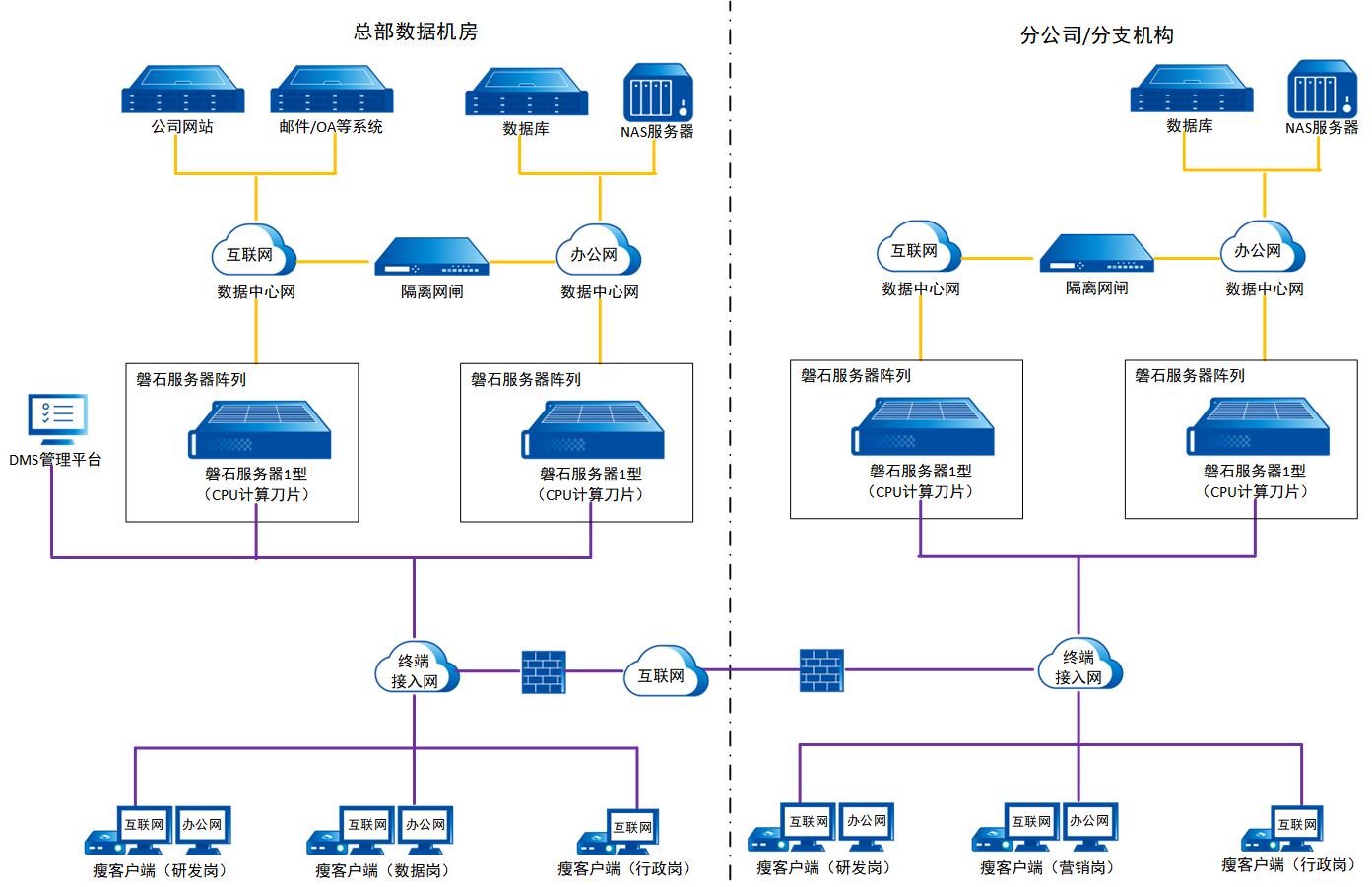
Headquarters and branches each have Internet and office networks, an isolation gateway and CPU Compute Blades. The branch also retains its local PANSTONE Server arrays.
The terminal access networks use the firewalls and Internet transport shown. This is a terminal-access path, rather than a direct bridge between business networks.
CT Client Terminals serve headquarters R&D, data and administrative roles, and branch R&D, marketing and administrative roles. DMS Desktop Management System is shown on the headquarters management side.
Solution value
Unify compliance, security, continuity and efficiency in one controlled computing system
Cover financial scenarios including investment research and risk control, domestic IT office work, counters and outlets, mobile collaboration and AI operations.
Highly sensitive data centrally controlled
Customer, transaction, investment research and model data are centrally controlled.
Orderly, controlled domestic IT migration
Domestic environments are centrally deployed, supporting phased migration and validation.
Stable professional performance
Configure resources as needed for quantitative work, risk control and data analysis.
Verifiable network isolation
Network boundaries are established jointly by structure and authorization relationships.
Counter, mobile and AI collaboration
Counter services, mobile work, remote approvals and AI work together.