

Industry challenges
As data assets become more concentrated, AI and collaboration become unavoidable
The traditional architecture of “computing on endpoints and isolation through rules” struggles to satisfy both security boundaries and business efficiency.
Must protect | High-value R&D data
Drawings and processes
3D models, assembly processes and machining parameters
BOMs and formulations
Bills of materials, yield curves and formulation ratios
Simulation and test data
CAE/CFD results and test reports
The greater the investment in R&D, the higher the density of data value and the more irreversible the cost of a leak.
Must also open up | AI and collaboration efficiency
AI for R&D and processes
Assisted design, code generation, intelligent scheduling and quality inspection
Cross-region and supply-chain collaboration
Multiple sites, external partners and mobile work add continuing pressure
Large models inherently need internet access
R&D data and internet capabilities interact in practice
Avoiding AI means falling behind; using AI without boundaries increases the risk of data leaving its domain.
Solution
Controlled cloud computing architecture: the enterprise data center centrally hosts computing, applications and data
R&D, office and internet networks connect independently; compute blades are assigned by role, and data remains within enterprise-controlled boundaries.
Core scenarios and solution features
R&D design and graphics workstations
Physical computers with GPUs; models and parameters stay off endpoints
Explore this scenarioMulti-network work
Independent instances and channels; switching can be recorded and checked
Explore this scenarioWork with AI
Independent instances; results return through a controlled zone
Explore this scenarioCross-region collaborative design
One set of cloud data, access from multiple locations and consistent versions
No endpoint data storage · Adjustable permissions · Auditable processes
Typical deployment
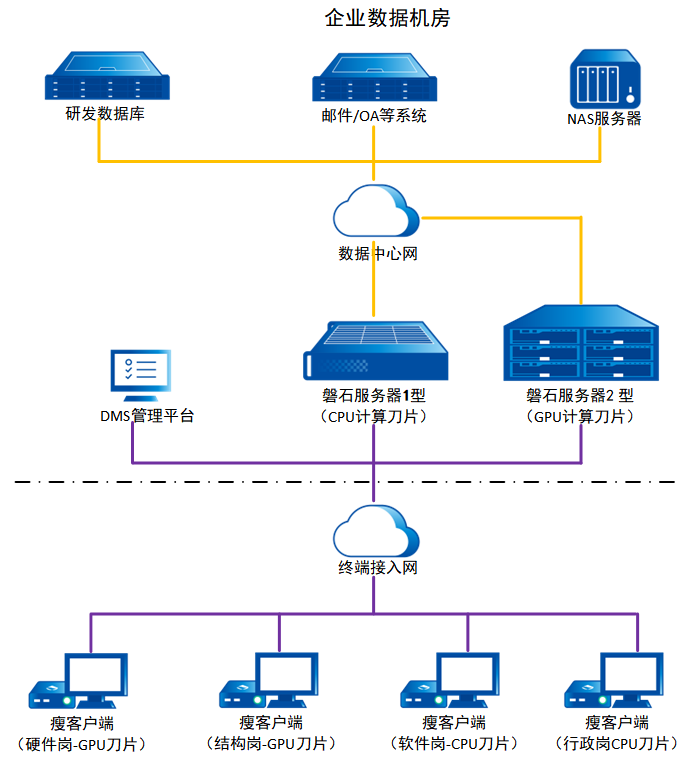
The enterprise data room holds the R&D database, email / OA systems and NAS storage, with centralized CPU and GPU resources.
Hardware and structural roles use GPU resources; software and administrative roles use CPU resources. CT Client Terminals connect through the terminal access network.
PANSTONE DMS (Desktop Management System) manages the corresponding server environments. Users connect to authorized computing resources through the terminal access network.
Solution value
Security without sacrificing R&D efficiency, with ongoing operation as people and projects change
Unify security, efficiency, compliance and operations in one controlled computing and management system.
Core assets under control
Data is centrally controlled and not stored on endpoints.
AI capabilities deployed securely
Controlled use with reviewable results.
Verifiable, auditable boundaries
Multiple networks and domains establish structural boundaries.
R&D efficiency without compromise
Stable performance for graphics and simulation.
Operations and cost optimization
Consolidated resources, with management adjusted to projects.