

Industry challenges
The longer the public-service chain, the more security domains, accountability and continuity need unified governance
Government intranets and external networks, dedicated business networks and the internet coexist; data processing, staff authorization and service assurance must be brought under control as services and responsibilities change.
Three governance checkpoints for government services
Data checkpoint | Security and confidentiality boundaries
Government data and personal information
Application materials, business records and public-service data need authorization by responsibility.
Endpoint and exchange risks
Removable media, email forwarding and peripheral access need clear policies and auditing.
Reduce dispersed retention and unauthorized external transfers.
Collaboration checkpoint | Multiple networks and interdepartmental processing
Dispersed departments and systems
Repeated logins, endpoint switching and duplicate data entry affect service efficiency.
Processing across stages
Acceptance, review, assistance and feedback must move promptly within authorized scopes.
Collaboration should not require joining networks or sharing accounts.
Service checkpoint | Domestic IT operations and continuity
Large, dispersed endpoint estates
Deployment, updates and fault handling struggle to cover service counters and local sites.
Domestic IT migration and counter services
Compatibility validation, shift use and peak-period support cannot all be interrupted.
Service peaks require rapid recovery and resource allocation.
Solution
Controlled dual-host office architecture: internal and external networks run independently, with information exchanged through controlled workflows
Government office work, internet use and data exchange run in clearly defined environments; DMS centrally manages user endpoints, policies and operations.
Core scenarios and solution features
Multi-network work
Domain-specific instances, isolated channels and approval workflows define information flows
Explore this scenarioWork with AI
Independent human / Agent instances; outputs enter workflows only after review
Explore this scenarioDomestic IT office work and unified operations
Phased migration after compatibility validation, with centrally maintained images, software and policies
Public-service counters and interdepartmental collaboration
Independent job environments support stable shift work and interdepartmental processing
Clear boundaries · Controlled exchange · Central operations · Continuous services
Typical deployment
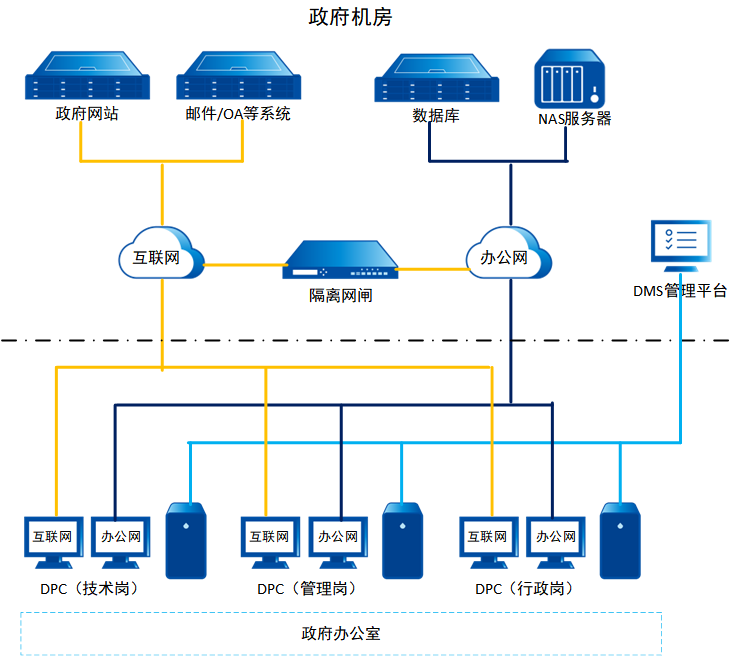
Technical, management and administrative roles use DPC Dual-Host PCs, with Internet and office networks connected to their respective local hosts.
The government website, email / OA, databases and NAS are deployed as shown, with an isolation gateway between Internet and office networks.
DMS Desktop Management System connects to DPC workstations through the management path shown. Business-network connections remain separate; sharing a workstation does not create a network bridge.
Solution value
Turn government security governance into stable, continuous public-service capability
Centrally manage data boundaries, desktop environments, exchange channels, staff permissions and local service support to keep government services running.
Clear government data boundaries
Important information and personal data
Used and managed in controlled environments
Smoother collaboration across networks
Domain-specific office work and controlled exchange
Less switching and manual transfer
Controlled human + AI collaboration
Independent instances separate risks
Reviewed results used according to rules
More orderly domestic IT operations
Compatibility validation and phased migration
Centrally maintained images and policies
More stable public services
Counter, local and collaborative roles
Receive continuous environment support