

Industry challenges
The more open research innovation networks become, the more research-output boundaries and accountability need control
Research groups, universities, enterprises and external partners participate together; research data, software environments and staff permissions must be brought under control as security domains and projects change.
Three structural pressures on research institutes
Research outputs and confidentiality boundaries
Important data and research assets
Experimental data, drawings, models and code need control by project, person and purpose.
Transfers and accountability
Exchange scope, approval workflows and accountable parties must be clear.
Reduce endpoint copies and risks from staff changes.
Multiple networks, domains and environment efficiency
Parallel networks and frequent switching
Research, office, laboratory, management and internet uses differ.
Dispersed environments and operations
Discipline-specific software, drivers and devices vary, making consistent versions difficult.
Everyday research should not be slowed by multiple endpoints and environment maintenance.
Industry–university–research collaboration and process governance
Joint research across organizations
Institutes, universities, enterprises and external partners need to share designated information and tools.
Changing people and projects
Joining, role changes, departures and research deliveries need coordinated governance.
Collaboration boundaries should be finely adjusted to project roles and time limits.
Solution
Controlled cloud computing architecture: organize research environments by security domain, project and role
The institute data center centrally hosts computing, applications and data; people enter authorized research environments, while endpoints mainly provide display and interaction.
Core scenarios and solution features
Multi-network work
Domain-specific instances and channels, with unified identity, authorization and switching
Explore this scenarioWork with AI
Independent human / Agent instances; reviewed results return through controlled paths
Explore this scenarioResearch simulation and visualization workstations
CPU / GPU configured by task, with drawings and results centrally retained
Explore this scenarioIndustry–university–research project collaboration
Independent collaboration spaces with manageable information exchange and member lifecycles
Domain-specific operation · Controlled data · Recorded collaboration · Recoverable results
Typical deployment
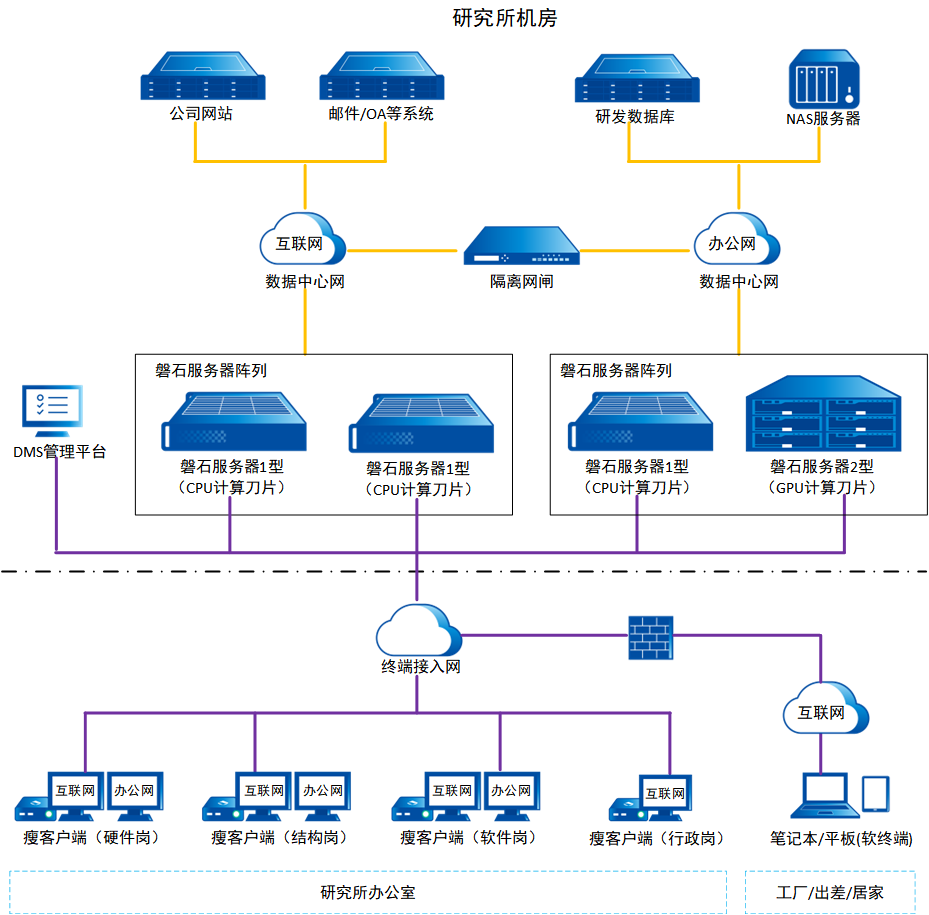
The institute data room holds the R&D database, NAS and computing resources. Internet and office domains have separate PANSTONE Server arrays, with CPU and GPU Compute Blades on the office side.
CT Client Terminals connect hardware, structural, software and administrative roles to their corresponding environments through the terminal access network.
Laptop / tablet SCT Software Client Terminals at factories, on business trips and at home use the firewall-protected path. DMS Desktop Management System configures the corresponding devices, users and policies.
Solution value
Support ongoing research, with outputs and accountability controlled and traceable within one system
Centrally manage research data, computing resources, discipline-specific software, collaboration spaces and staff lifecycles to support research across disciplines and organizations.
Clear research-data boundaries
Drawings, models and code centralized
Used in controlled environments
More efficient multi-network office work
Domain-specific instances centrally maintained
Less switching and per-device maintenance
Secure human + AI collaboration
Independent instances separate risks
Results reviewed before returning
Simulation resources matched to tasks
CPU, GPU and memory resources
Configurations validated against typical tasks
Traceable industry–university–research collaboration
Project authorization, exchange and delivery
Adjusted promptly as membership changes